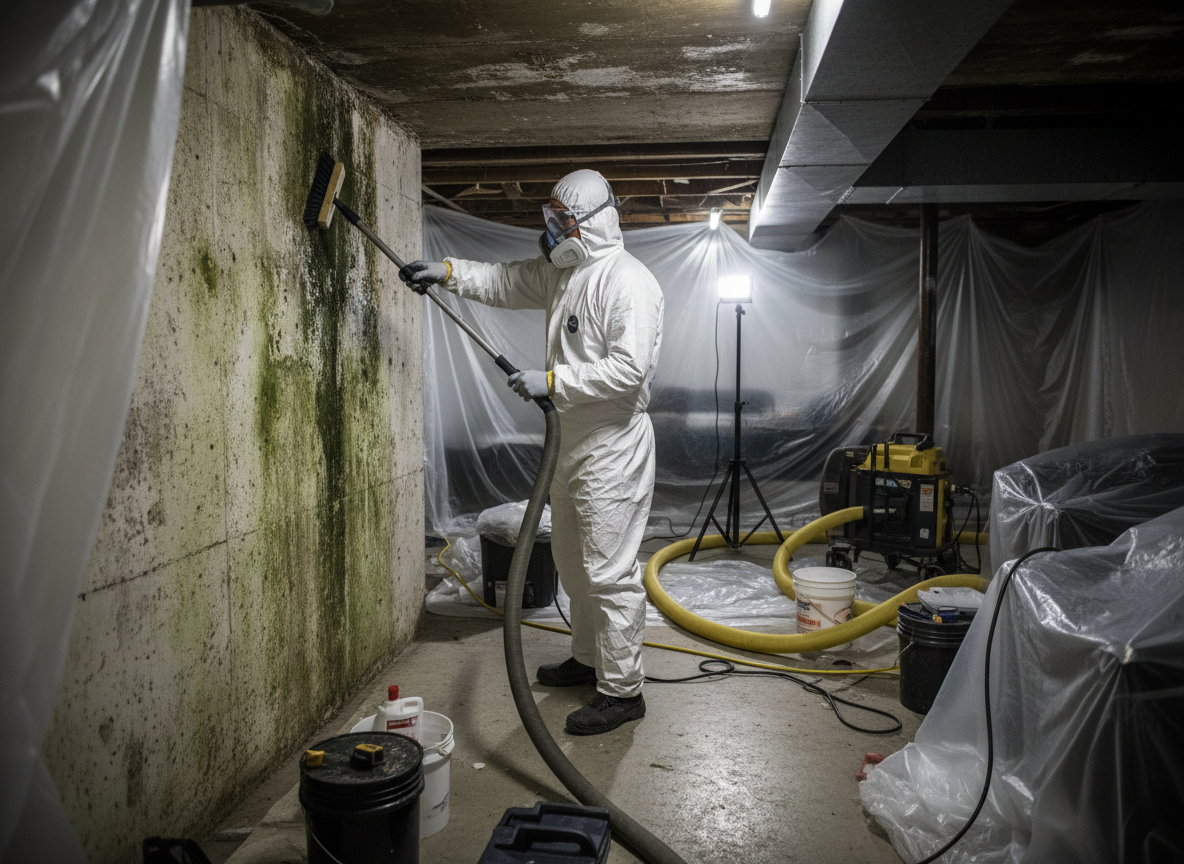
Winchester sits in a hot-summer Mediterranean climate where dry summers give way to occasional winter rains that can pool against older slab foundations common in Winchester Ranch and French Valley. Homes built before 2000 often lack modern vapor barriers, allowing moisture from irrigation runoff near Diamond Valley Lake to migrate into crawl spaces and wall cavities. When these conditions persist, stachybotrys and aspergillus colonies form behind baseboards and under carpet padding, requiring negative-air containment before any demolition begins.
Technicians at our Winchester location follow Riverside County guidelines that mandate separation of affected and unaffected zones during removal. We use HEPA-filtered air scrubbers and antimicrobial rinses rated for porous materials like drywall and insulation found in single-story ranch homes throughout the area. Edge cases include hidden growth inside HVAC returns that serve multiple bedrooms, where incomplete cleaning leads to rapid re-growth once the system cycles again after the first rain.
Clearance testing with spore-trap sampling occurs only after source removal and drying verification with moisture meters. Homeowners in Menifee and Temecula frequently call after noticing musty odors following monsoonal storms that overwhelm French Valley drainage ditches. Our crews document every step with photos and chain-of-custody forms so insurance adjusters receive the data they need without delays.
Post-remediation, we advise sealing exterior grading around Winchester Museum-area properties where soil settles unevenly and directs water toward stucco walls. This step prevents recurrence better than repeated treatments alone.
Technician insight
In Winchester the thing that catches most people out with mold remediation company is irrigation overspray from French Valley lots hitting older stucco on homes near Diamond Valley Lake. The dry summers hide the problem until winter rains push moisture behind the paper facing, so what looks like a small bathroom stain often turns into full wall removal once we open the cavity.
Hidden growth behind kitchen cabinets
A Winchester Hills homeowner noticed a persistent odor after heavy rain. We found water had wicked under the slab edge and wicked up into particleboard cabinets. Containment was set across the kitchen, cabinets and base plates were removed, the subfloor dried, and new moisture barriers installed before cabinets were replaced.
How it works
- 1
Initial Assessment
Technician arrives within hours, maps moisture with infrared and pin meters, and identifies all affected materials in the structure.
- 2
Containment Setup
Plastic barriers and negative air machines isolate the work zone from the rest of the Winchester home to prevent cross-contamination.
- 3
Removal and Cleaning
Porous materials are removed, hard surfaces are HEPA-vacuumed and treated, then the area is dried to under 15 percent moisture content.
- 4
Clearance and Documentation
Independent air sampling confirms levels meet post-remediation criteria before barriers come down and the space is returned to use.
Pricing
Cost depends on square footage affected, depth of hidden growth, and whether HVAC systems require cleaning.