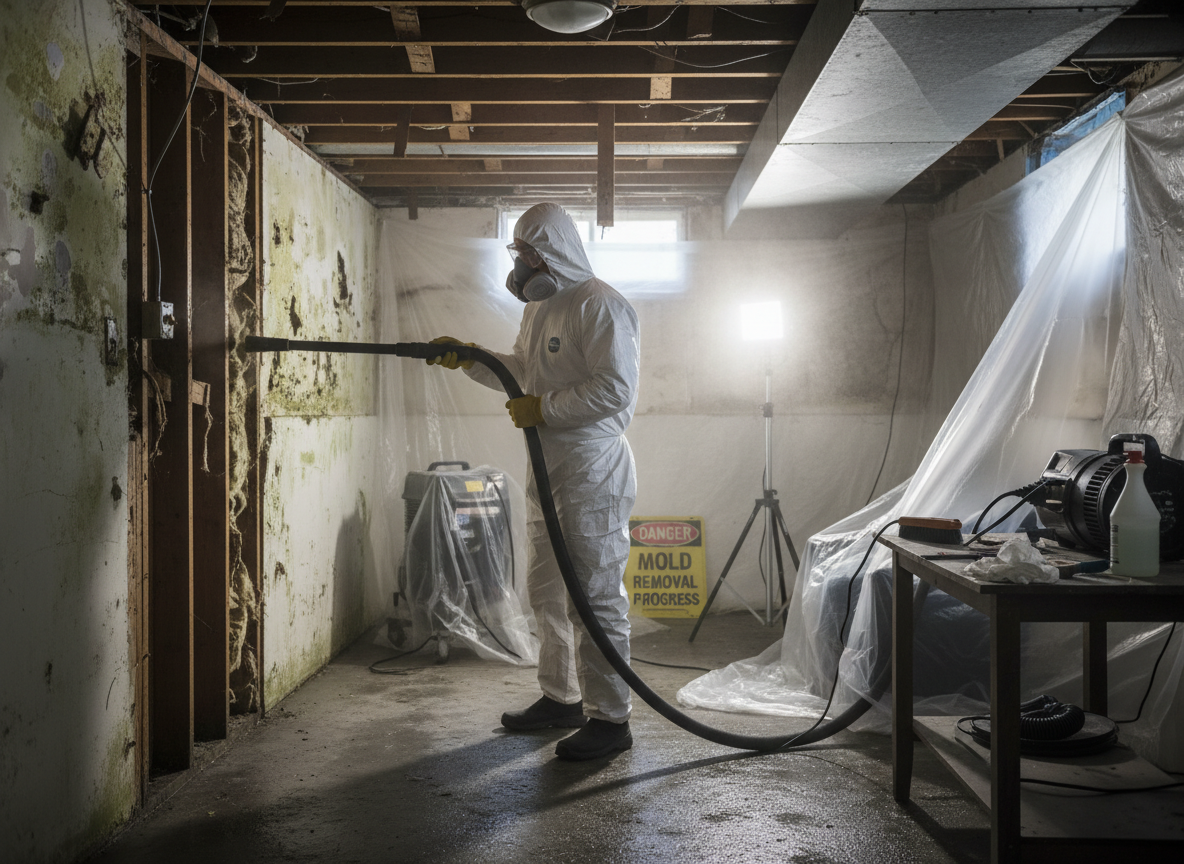
Winchester homes in neighborhoods like Winchester Hills and French Valley often feature stucco exteriors and slab foundations that trap moisture from irrigation or AC condensate during the long dry summers. Mold abatement here requires isolating affected cavities without disturbing settled spores that can travel across the open terrain toward Diamond Valley Lake properties. Technicians must account for older single-story ranch homes built in the 1980s and 1990s where paper-faced drywall meets poorly sealed windows, allowing repeated wetting cycles even when rainfall is minimal.
In Riverside County, mold abatement jobs frequently involve removing growth from HVAC plenums and under-slab vapor barriers common in Winchester Ranch tracts. Containment barriers must be negative-air sealed to prevent cross-contamination into adjacent living spaces, especially when work occurs near high-traffic routes like Winchester Road. Edge cases include mold migrating into insulation batts behind bathroom tubs where original construction lacked proper weep holes, requiring selective demolition rather than full wall removal to preserve structural integrity.
Abatement protocols emphasize source removal over surface treatments because the region's intense summer heat can reactivate dormant spores once humidity spikes from indoor leaks. Crews document moisture meter readings at multiple depths in framing members and verify clearance with post-remediation air sampling before any reconstruction. Properties near Hemet and Temecula share similar soil conditions that promote capillary rise, so abatement plans routinely include recommendations for improved grading and ventilation to reduce recurrence risk.
Technician insight
In Winchester, the thing that catches most people out with mold abatement is hidden moisture trapped behind stucco on pre-2000 homes in Winchester Ranch where the dry summers hide ongoing AC drip issues that travel along slab edges into French Valley properties.
Shower Wall Growth in French Valley Home
Homeowner noticed dark staining along the tub surround in a single-story ranch house. Inspection found water had wicked into the drywall and insulation behind the shower because the original tile lacked proper waterproofing at the curb. We contained the bathroom, removed the compromised sections, dried the framing, and verified clearance with air samples. The family returned to a dry, odor-free space with guidance on improved ventilation suited to the local climate.
How it works
- 1
Initial Assessment
Technician arrives within hours, maps visible growth and uses moisture meters plus thermal imaging to locate hidden water in walls, ceilings and subfloor areas typical of Winchester construction.
- 2
Containment Setup
Plastic barriers and negative-air machines isolate the work zone so spores do not migrate into unaffected rooms or HVAC systems serving French Valley and Winchester Hills homes.
- 3
Removal and Cleaning
Affected materials are removed, surfaces HEPA-vacuumed and treated with EPA-registered antimicrobials, with special attention to stucco-clad exteriors and slab edges common in the area.
- 4
Drying and Verification
Industrial dehumidifiers and air movers dry the structure, followed by post-remediation testing to confirm mold levels meet clearance criteria before any rebuild.
- 5
Prevention Guidance
Homeowner receives a written report noting local factors such as AC condensate routing and grading adjustments that reduce future risk in Riverside County's dry climate.
Pricing
Cost depends on square footage affected, depth of hidden growth, and whether HVAC or sub-slab areas are involved; quotes provided after inspection.