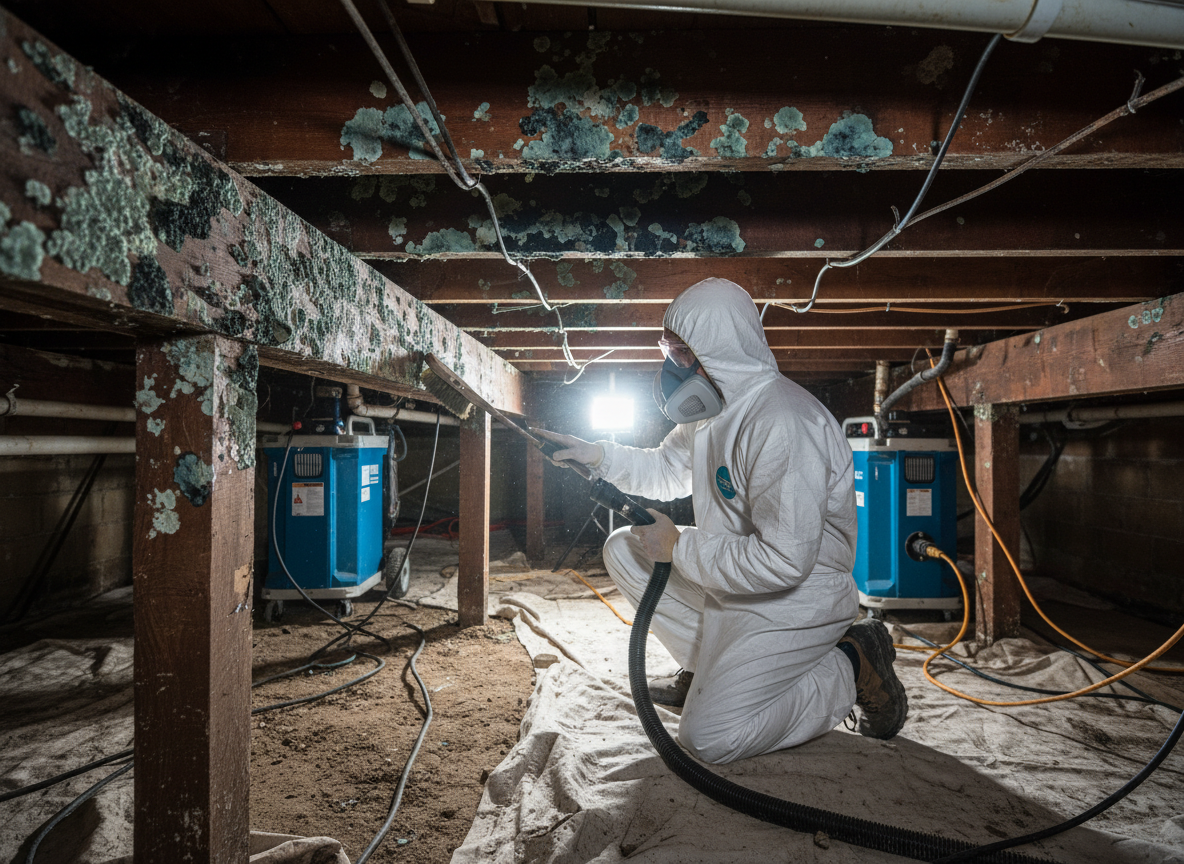
Winchester sits in a hot-summer Mediterranean climate where dry summers mask winter rain events that soak crawl spaces under homes in Winchester Ranch and French Valley. Irrigation systems tied to Diamond Valley Lake keep soil moisture high around foundations even when surface conditions look arid, allowing mold to establish on joists and insulation. Homes built before modern vapor barriers often lack proper grading, so water pools against stem walls during the brief wet season and lingers in the enclosed space.
Crawl spaces in Menifee and Hemet border properties frequently connect to Winchester addresses through shared drainage patterns. When French Valley farms or residential sprinklers run on timers, excess water migrates under slabs and into vented crawl areas. Removing mold here requires sealing soil with heavy-duty liners and installing directed dehumidification rather than simple surface sprays, because the source is continuous ground moisture rather than a one-time leak.
Access in older Winchester Ranch homes is often limited to narrow perimeter vents and low clearance near the 35952 Winchester Rd corridor. Technicians must navigate around plumbing, ductwork and electrical runs while containing spores so they do not enter living areas above. Post-remediation verification includes moisture meter readings at multiple soil and wood points to confirm levels stay below thresholds that allow regrowth during the next winter rain cycle.
Technician insight
In Winchester, the thing that catches most people out with crawl space mold removal is how French Valley irrigation keeps the soil damp all summer even though the air feels bone-dry. Homeowners vent the space thinking it will dry out, but that just pulls more humid air across the moist dirt and feeds the mold on the joists.
Winchester Hills Crawl Space After Winter Rains
Heavy winter rain followed by continued sprinkler use left standing water against the stem wall of a 1990s home. Inspection found black mold on floor joists and saturated fiberglass batts. Crew installed a sealed liner, cleaned the framing, and added a small dehumidifier tied to a French drain extension that routes water toward the street instead of back under the house.
How it works
- 1
Initial Assessment
Technician enters the crawl space through existing vents or access panels and maps visible mold, moisture sources and insulation condition while noting grading around the perimeter in Winchester Hills or French Valley.
- 2
Containment Setup
Plastic sheeting and negative air machines isolate the crawl space from the home interior to prevent spore migration into living areas during removal.
- 3
Source Correction
Standing water is removed, soil is covered with a sealed liner, and any irrigation runoff near Diamond Valley Lake influence zones is redirected away from the foundation.
- 4
Mold Removal and Drying
Affected wood and insulation are cleaned or replaced, then commercial dehumidifiers run until wood moisture content drops and stays low through the dry summer period.
- 5
Final Verification
Post-job moisture readings and visual inspection confirm the space meets clearance criteria before equipment is removed and vents are restored.
Pricing
Cost depends on crawl space size, depth of mold into insulation and wood, and whether additional drainage fixes are needed around Winchester Ranch lots.