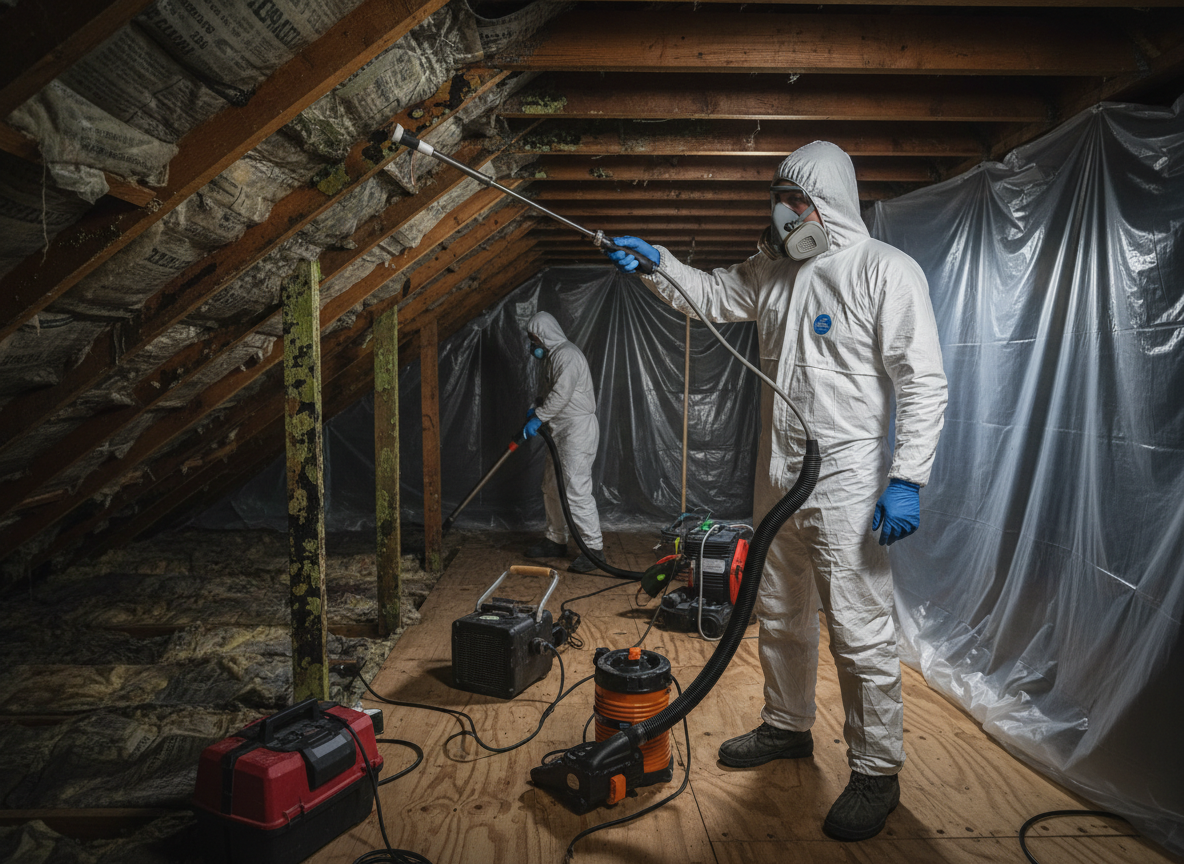
Winchester homes in neighborhoods like Winchester Ranch and French Valley often feature older rooflines and limited attic ventilation that trap moisture even during the dry summers typical of the region's hot-summer Mediterranean climate. Roof leaks around skylights or ridge vents allow water intrusion that feeds mold growth on rafters and insulation without obvious interior signs until odors appear. Attic mold testing begins with moisture mapping and air sampling to identify hidden colonies before any removal work starts, preventing spores from migrating into living spaces during cleanup.
Removal in these Riverside County properties requires full containment barriers and negative air machines because many homes sit on sloped terrain near Diamond Valley Lake where wind-driven rain can push water under eaves. Technicians remove affected insulation and treat wood surfaces with EPA-registered antimicrobials, then address the underlying leak source such as compromised flashing or gutter overflow. Post-remediation clearance testing confirms spore levels match outdoor baselines before insulation is replaced and vents are upgraded for better airflow.
Homeowners in Winchester Hills frequently overlook how seasonal temperature swings between hot days and cooler nights create condensation on metal roof decking, a common trigger for attic mold in homes built before current ventilation codes. Proper remediation includes installing additional soffit and ridge vents sized for the attic volume and sealing penetrations around plumbing stacks. This approach reduces recurrence risk in the dry climate while accounting for occasional winter rains that can overwhelm older drainage around the property.
Technician insight
In Winchester, the thing that catches most people out with Attic mold testing and removal is how the dry summers mask ongoing condensation problems in older Winchester Ranch and French Valley homes where poor ridge venting lets roof decking sweat at night, turning small leaks near Diamond Valley Lake into widespread mold before any musty smell reaches the living areas.
Winchester Hills Attic Discovery
A homeowner in Winchester Hills reported a persistent odor after winter rains. Inspection revealed mold on rafters from a slow ridge vent leak that had gone unnoticed through the dry season. Containment was installed, affected insulation removed, wood treated, and extra soffit vents added. Clearance testing passed and the attic remained dry through the following summer.
How it works
- 1
Inspection and Testing
Technicians perform a full attic walkthrough with moisture meters and borescopes, collecting surface and air samples for lab analysis to map contamination extent.
- 2
Containment Setup
Plastic sheeting and negative air machines isolate the attic from the rest of the home to prevent spore spread during removal.
- 3
Mold Removal and Treatment
Affected materials are removed, wood surfaces are cleaned and treated, and the source of moisture such as roof leaks is repaired.
- 4
Ventilation Improvements and Clearance
Additional vents are added if needed, followed by post-remediation testing to verify safe spore levels before re-insulation.
Pricing
Pricing varies by attic size, contamination depth, and required ventilation upgrades; site assessment provides exact scope.